The “Chin-Up” exercise is a classic and effective workout for strengthening the upper body, specifically focusing on the arm and back muscles. This exercise is similar to the “Pull-Up,” but the main difference lies in the hand placement. In a “Chin-Up,” the palms face towards the face, which increases the focus on the biceps muscles. This exercise is highly suitable for individuals looking to strengthen and increase the volume of their arm and back muscles.
In addition to affecting the arm muscles, “Chin-Up” helps improve the strength and endurance of the upper body muscles. Because it uses body weight as resistance, it is considered one of the best exercises for increasing relative strength and improving physical capabilities in daily life and various sports.
Target Muscle in Chin-Up
The primary target muscle in the “Chin-Up” exercise is the biceps, located in the front of the arm. This muscle is responsible for bending the elbow and pulling the body upwards. Compared to the “Pull-Up,” the “Chin-Up” places more emphasis on the biceps, making these muscles more engaged and bearing more load.
Due to its significant impact on the biceps, the “Chin-Up” exercise is considered one of the best for increasing the strength and size of these muscles. Regular performance of this movement helps strengthen and define the biceps, which is very important for individuals aiming to build strong and muscular arms.
Secondary Muscles Involved in Chin-Up

In addition to the biceps, the “Chin-Up” exercise also heavily involves the latissimus dorsi, the largest muscle in the back. This muscle is responsible for pulling the arms downwards and performing the upward pulling motion of the body. In fact, the “Chin-Up” remains an effective exercise for strengthening the back muscles.
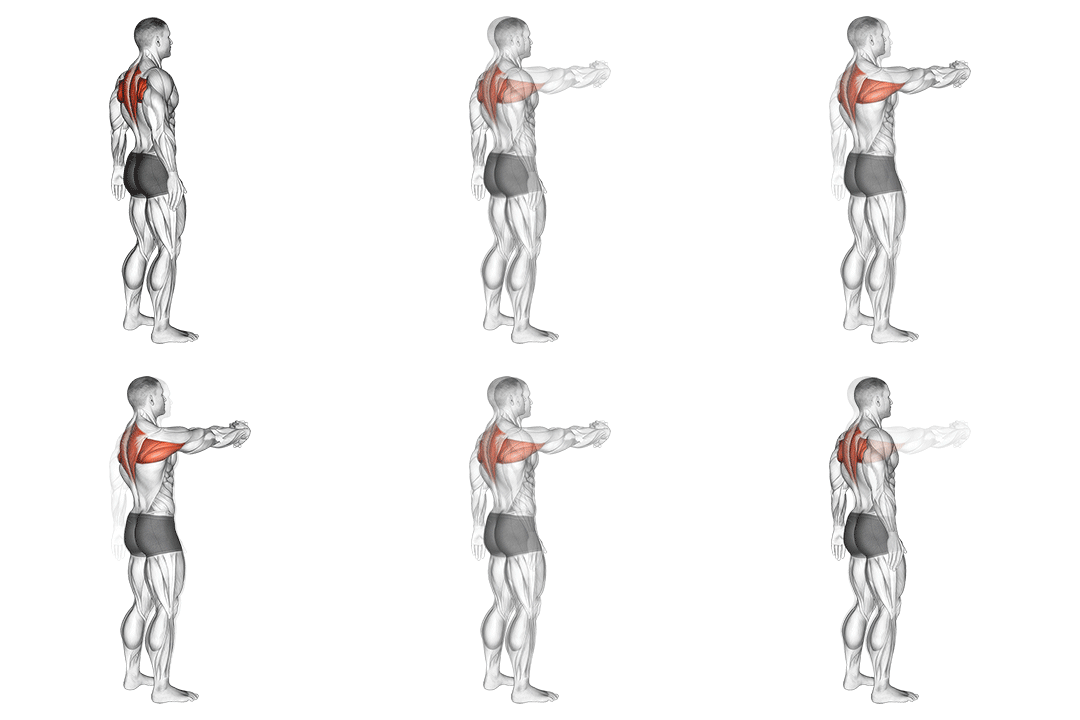
Furthermore, the shoulder muscles, particularly the rear deltoids, rhomboids, and trapezius muscles, are also activated during this exercise. The core muscles also play a crucial role in maintaining balance and stability throughout the movement.
How to Perform Chin-Up

To perform the “Chin-Up,” first stand under a pull-up bar and grip the bar with both hands. Space your hands about shoulder-width apart or slightly less. Grip the bar so that your palms face towards your face. Then, hang freely from the bar, lifting your feet slightly off the ground.
Using your arm and back muscles, pull your body upwards until your chin is above the bar. Throughout the movement, keep your back straight and your core engaged to prevent swinging. Then, slowly lower your body back to the starting position and repeat the exercise. Maintaining control and precision throughout the movement is crucial to prevent injury.
Equipment Needed
To perform the “Chin-Up,” you only need a pull-up bar, which must be securely and firmly installed. This bar can be placed in a doorway, on a wall, or as part of a pull-up station. It is important that the bar is positioned so you can easily hang from it and pull your body up completely.
If you find the “Chin-Up” difficult, you can use resistance bands or assisted pull-up machines that help reduce your body weight, making the movement easier to perform. Additionally, wearing workout gloves can help reduce pressure on your hands and prevent calluses.
The main difference is in the hand placement. In a chin-up, the palms face towards the face, while in a regular pull-up, the palms face forward. Chin-ups emphasize the biceps more, whereas pull-ups engage the back muscles more.
Although chin-ups can be challenging for beginners, with regular practice and the use of various aids like resistance bands, one can gradually learn this movement and gain the necessary strength to perform it.
Performing chin-ups 2 to 3 times a week with adequate rest between training sessions is recommended to allow muscles time to recover and strengthen.
To increase the number of “Chin-Ups,” you can use training methods such as gradually increasing the number of repetitions, reducing rest time between sets, or using additional weights.
How to perform
-
Step 1
Grip the pull-up bar with an underhand grip, so your body hangs from the bar with your arms fully extended. This is the starting position.
-
Step 2
Slowly pull yourself up until your chin is above the bar. During this movement, contract your back and lat muscles and hold this position for a moment.
-
Step 3
Slowly return to the starting position and repeat the exercise for your desired number of repetitions and sets.
-
Step 4
Throughout the exercise, your legs should remain aligned with your torso.