
The rotational knee raise on the bar is a challenging exercise that, in addition to strengthening the abdominal muscles, helps improve balance and core stability. This exercise requires strength in the abdominal muscles and hands and is particularly suitable for individuals looking for variety in their abdominal training. The rotational bar exercise has different effects compared to static abdominal exercises because it engages the abdominal muscles dynamically and rotationally.
The rotational knee raise on the bar involves lifting the knees towards the chest while rotating to the sides, which activates the abdominal muscles, especially their side portions. Correct and controlled execution of this movement requires sufficient focus and body control to prevent injury.
Target Muscle

The target muscle in this exercise is the Rectus Abdominis, which is stressed by lifting the knees. These muscles are particularly affected in the lower part and require more contraction and control with each lift and rotation.
The rotational movement in this exercise also activates the abdominal muscles more and helps in better strengthening and shaping the muscles. Focusing on these muscles during the exercise and performing it slowly and controlled increases the effectiveness of this exercise on the abdominal muscles.
Secondary Muscles Involved
In this exercise, the Obliques play a secondary and stabilizing role. These muscles are activated during the body’s rotation to the sides and help create a stable and controlled movement. Strengthening these muscles increases stability and overall strength of the core area.
In addition to the obliques, the Hip Flexors are also involved and help lift the knees. These muscles, located in the front of the thigh, play an important role in leg movements and make the exercise more efficient.
How to Perform
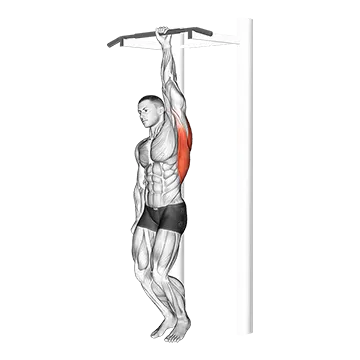
To perform this exercise, first hang from a pull-up bar with your hands shoulder-width apart. Your legs should hang freely and comfortably. Use your abdominal muscles to lift your knees towards your chest, and simultaneously rotate your body to one side as you lift your knees.
After reaching the peak, slowly lower your knees and return to the starting position. Then, repeat the movement with a rotation to the other side. Focusing on breathing and controlling the movement throughout the exercise is important to apply appropriate pressure to the abdominal muscles and prevent sudden, unstable movements.
Equipment Needed
This exercise requires a strong and safe pull-up bar from which you can easily hang. The pull-up bar should be at an appropriate height so that your feet do not touch the ground when hanging and you can perform the movement easily.
To increase the challenge of the exercise, ankle weights can be used. Ankle weights add resistance to the exercise, requiring more effort to lift the knees, thereby increasing the pressure on the abdominal muscles.
This exercise is more suitable for individuals at an intermediate or advanced level due to the high strength required in the abdomen and arms.
3 sets of 8 to 10 repetitions are recommended, but individuals can adjust the number of repetitions based on their fitness level.
Yes, ankle weights can make the exercise more challenging and increase the pressure on the muscles.
Yes, due to the rotational movements, the oblique muscles are also activated and strengthened in this exercise.
This exercise strengthens the abdominal muscles, but to reduce belly fat, you also need a proper diet and cardiovascular exercises.
How to perform
-
Step 1
First, stand under a pull-up bar and lift yourself off the ground so your body hangs above the ground.
-
Step 2
Lift your knees towards one side of your body until you feel a stretch in your abdominal muscles and hold for a few seconds.
-
Step 3
Return to the starting position and repeat the movement in the opposite direction.
-
Step 4
Perform the exercise for the desired number of repetitions and sets.