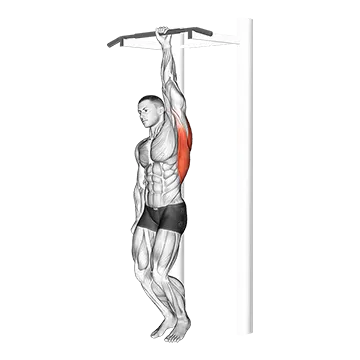
The “one-arm-hang” exercise is an isometric exercise that increases grip strength and muscle endurance. This seemingly simple exercise is challenging in practice and can help improve muscle control and body balance. By hanging from a bar with only one hand, an individual not only strengthens the target muscles but also improves coordination among various body muscles. This exercise is commonly used as part of strength and endurance training programs, especially in sports requiring high grip strength and endurance, such as rock climbing, parkour, and gymnastics. Additionally, this movement can be used as part of general fitness programs to strengthen the upper body and increase overall body strength.
Target Muscles in One-Arm Hang
The primary target muscles in the “one-arm-hang” movement are the forearm and finger muscles. These muscles are responsible for grip strength and holding body weight, and they are strengthened by performing this exercise. The forearm muscles are heavily stressed by gripping the bar and holding the body in a hanging position, and their endurance increases.
In addition to the forearm muscles, the triceps, shoulders, and upper back muscles are also heavily involved. These muscles help maintain body stability and allow the individual to remain in the hanging position for a longer duration.
Secondary Muscles Involved in One-Arm Hang
In the “one-arm-hang” movement, several secondary muscles are also activated. The latissimus dorsi (lats), which are large back muscles, act as the main secondary muscles in this exercise. These muscles play an important role in this movement by helping to keep the body stable.
In addition to the lats, the deltoids (shoulders), trapezius muscles (traps), and abdominal muscles are also secondarily involved in this exercise. These muscles help keep the body stable in the hanging position and distribute the load evenly throughout the body.
How to Perform the One-Arm Hang
To perform the “one-arm-hang” exercise, you first need access to a pull-up bar or any bar that can support your body weight. Grip the bar firmly with one hand and slowly lift your body off the ground until you are fully hanging. Ensure your other hand is free and by your side.
In this position, try to keep your body straight and stable. Breathe regularly and deeply, and try to remain in this position for a specified duration. As you gain strength over time, you can increase the hanging duration. To exit the movement, slowly lower your body to the ground and then release your hand from the bar.
Equipment Required
To perform the “one-arm-hang” exercise, you need a pull-up bar or any type of bar capable of supporting body weight. This bar should be installed in a way that allows you to hang easily and provides enough space for body movement.
If you do not have access to a pull-up bar, you can use similar equipment such as training machines with hanging handles or even sturdy tree branches. Additionally, if you need to reduce pressure on your hands, you can use resistance bands or training gloves for hand protection.
Yes, but it’s better for beginners to start with two hands and then gradually progress to one hand. This allows the muscles to strengthen slowly and reduces the risk of injury.
This duration depends on your strength and endurance level. Beginners can start with 10-15 seconds and gradually increase this time.
Yes, the “one-arm-hang” directly increases grip strength and endurance of the forearm and finger muscles.
Yes, this exercise helps strengthen the back muscles, particularly the latissimus dorsi and trapezius.
How to perform
-
Step 1
To begin this exercise, grasp the pull-up bar with one hand, ensuring your palm faces outward.
-
Step 2
Place your feet flat on the ground and put all your body weight onto the hand holding the bar, holding for 15 seconds.
-
Step 3
Perform this exercise for your desired number of repetitions.