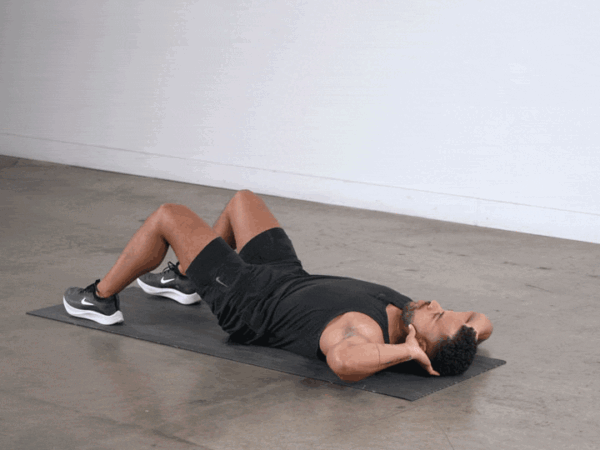

The Decline Reverse Crunch is an effective exercise for strengthening the abdominal muscles, performed using an incline bench. This movement is similar to the regular Reverse Crunch, but the incline of the bench increases the intensity of the exercise. In this movement, the legs are brought up towards the chest while the body is positioned at a downward incline. Due to the use of the incline bench, this exercise places greater emphasis on the lower abdominal muscles, helping to focus more on this area. Additionally, it improves balance and control during abdominal exercises and is an excellent workout for strengthening the core.
Target Muscle in Decline Reverse Crunch
The primary target muscle in the Decline Reverse Crunch is the Rectus Abdominis, particularly its lower portion. This muscle is responsible for bringing the legs towards the body and is heavily engaged throughout the movement. Using an incline bench increases the pressure on this part of the abdominal muscles. The main focus of this exercise is to strengthen and shape the lower abdominal muscles, which is very beneficial for achieving a flat and strong midsection. Strengthening this muscle not only contributes to a better physique but also improves overall performance in daily movements and activities.
Secondary Muscles Involved in Decline Reverse Crunch
Alongside the main abdominal muscle, secondary muscles such as the Hip Flexors are also involved in this exercise. These muscles help in bringing the legs up towards the abdomen and assist in performing the movement correctly. The Erector Spinae muscles in the lower back are also indirectly engaged, helping to maintain body balance. Furthermore, the Obliques play a role in stabilizing the movement and preventing body rotation. These muscles help maintain body stability throughout the exercise and prevent premature fatigue.
How to Perform the Decline Reverse Crunch
To perform the Decline Reverse Crunch, first lie down on an incline bench and place your hands behind or to the sides of the bench for stability. Bring your legs up towards your abdomen, so that your knees move towards your chest. During this phase, you should use your abdominal muscles to lift your legs. After bringing your legs up and your knees close to your chest, pause briefly and then slowly return your legs to the starting position. Keep your lower back flat and without arching throughout the movement to prevent injury. You can perform this exercise for a specified number of repetitions and gradually increase the intensity of the workout over time.
Equipment Needed
To perform the Decline Reverse Crunch, you need an incline bench, which is available in most gyms. The incline bench allows you to adjust the angle of the incline and control the intensity of the exercise by changing the degree of the slope. You can also use an exercise mat for added comfort during the workout. This exercise does not require any special additional equipment, and you can perform it with your body weight. However, for those looking to increase the intensity of their workout, ankle weights can be used to add more resistance to the muscles.
This exercise is suitable for individuals with intermediate to advanced fitness levels. Beginners are better off starting with simpler exercises first.
If performed correctly with a flat back, the risk of injury is very low. However, individuals with back problems should consult a doctor before performing this exercise.
To start, 3 sets of 10 to 15 repetitions are recommended. Over time, you can increase the number of repetitions and sets.
Yes, using an incline bench places more emphasis on the lower abdominal muscles, leading to greater strengthening in this area.
How to perform
-
Step 1
Prepare an incline bench and set it to a moderate angle. Lie down on the bench with your head at the higher end and your feet at the lower end. Grip the handles or sides of the bench above your head for support.
-
Step 2
Bend your knees and lift your legs so that your thighs are perpendicular to the bench and your shins are parallel to the bench (a 90-degree angle at the hips and knees). Engage your abdominal muscles by drawing your navel towards your spine.
-
Step 3
Tighten your abdominal muscles to prepare for the movement. Using your lower abdominal muscles, lift your hips off the bench and bring your hips towards your chest. Your knees should move towards your face. Exhale as you lift your hips.
-
Step 4
At the peak of the movement, your hips should be lifted off the bench, and your lower back should slightly elevate. Your knees should be close to your chest. Hold this position briefly, ensuring a strong contraction in your lower abdominal muscles.
-
Step 5
Slowly and with control, return your hips to the starting position on the bench, preventing your legs from dropping due to gravity. Inhale as you lower your hips back to the starting position.