The “Bench Crunch Core” exercise is one of the effective movements for strengthening the core muscles and abdominal muscles. This exercise is performed using a bench or table and specifically targets the abdominal muscles. In this movement, the body is positioned lying on the bench, and by performing the crunch movement, direct pressure is applied to the abdominal muscles.
Due to being performed on a bench, this movement provides more stability to the body compared to regular crunches and puts less pressure on the lower back. For this reason, this exercise is recommended for strengthening abdominal muscles and preventing back injuries.
Target Muscle in Bench Crunch
The primary target muscle in the “Bench Crunch Core” movement is the Rectus Abdominis. This muscle is responsible for forward torso flexion movements and is engaged with each bend and lift during this exercise. Strengthening this muscle can contribute to overall core strength and improve abdominal appearance.
The rectus abdominis plays a significant role in maintaining balance and body endurance. With regular training of this muscle, daily functions can be performed better, and the core of the body can be strengthened.
Oblique Muscles Involved in Bench Crunch
In addition to the rectus abdominis, other muscles are also involved in the “Bench Crunch Core” movement. The external obliques and internal obliques are partially activated in this exercise, helping to stabilize the torso and maintain balance. These muscles are particularly important when flexing the body forward.
The hip flexors are also indirectly involved in this movement. These muscles assist in bringing the body upwards and play a role in stabilizing the body during the crunch.
How to Perform the Bench Crunch
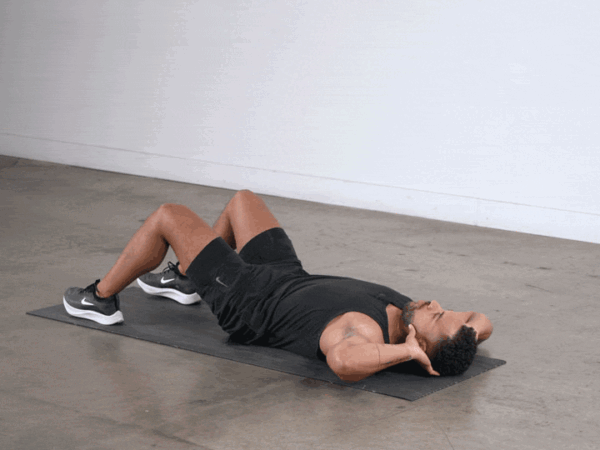
To perform the “Bench Crunch Core” exercise, first lie down on a bench or table so that your feet are positioned lower than your body. Place your hands behind your head or by your ears, but be careful not to strain your neck. Then, using your abdominal muscles, flex your upper torso forward and upward.
After reaching the highest point, pause briefly and then slowly return your body to the starting position. Ensure your lower back moves in a controlled manner without excessive strain to prevent potential injuries.
Equipment Required
To perform the “Bench Crunch Core” exercise, you need a bench or table that you can comfortably lie on. This bench can be flat or slightly inclined to increase the pressure on the abdominal muscles. You can also use an exercise mat for added comfort.
No additional weights or equipment are required for this exercise, but some individuals may choose to use small weights in their hands to increase the intensity of the workout and apply more pressure to the abdominal muscles.
Yes, this exercise is suitable for beginners as its intensity can be controlled by adjusting the bench angle and the number of repetitions.
To increase the intensity, you can use small weights in your hands or increase the number of repetitions.
If performed correctly with proper technique, this exercise does not harm the lower back. Using a bench helps reduce pressure on the lower back.
For starters, 3 sets of 12 to 15 repetitions are recommended. Depending on individual ability and goals, the number of sets and repetitions can be modified.
How to perform
-
Step 1
Lie on your back with your feet placed on a bench, keeping your knees bent at a 90-degree angle. Place your hands on your chest or by the sides of your head.
-
Step 2
Lift your head, shoulders, and chest off the ground, moving towards your knees while flexing your spine.
-
Step 3
Hold this position for a moment, then return to the starting position.
-
Step 4
Perform the exercise for the desired number of repetitions and sets.